1. The prefrontal cortex stays online under stress
In someone taking real accountability:
- The prefrontal cortex (judgment, impulse control, empathy) remains active even when triggered
- They experience anger, shame, or fear without acting it out
- They pause before responding
🔹 You’ll see this as:
- Fewer impulsive reactions
- No escalation when challenged
- Willingness to sit with discomfort
If this doesn’t happen, there is no accountability, only performance.
2. The amygdala is regulated, not indulged
Accountability requires learning to down-regulate the threat response.
Neurologically this means:
- Reduced amygdala reactivity
- Faster return to baseline after stress
- No need to dominate or punish to feel safe
🔹 Observable behaviour:
- They tolerate “no”
- They don’t retaliate when boundaries are set
- They don’t seek control to soothe anxiety
3. Shame is processed, not externalised
In non-accountable people, shame triggers defence:
- Blame
- Rage
- Minimisation
- Victim-playing
In accountable brains:
- Shame activates self-reflection, not aggression
- The person can say “I did this” without adding “but…”
Neurologically, this requires integration between:
- Limbic system (emotion)
- Prefrontal cortex (meaning-making)
This integration is hard — and rare — without long-term work.
4. Empathy becomes stable, not situational
Real accountability means empathy is consistent, not switched on only when consequences loom.
This requires:
- Sustained activation of empathy networks (medial prefrontal cortex, insula)
- The ability to hold another person’s pain without centring the self
🔹 Behaviourally:
- No rushing the victim to forgive
- No demands for reassurance
- No expectation of access, closeness, or redemption
5. The reward system is retrained
This is crucial.
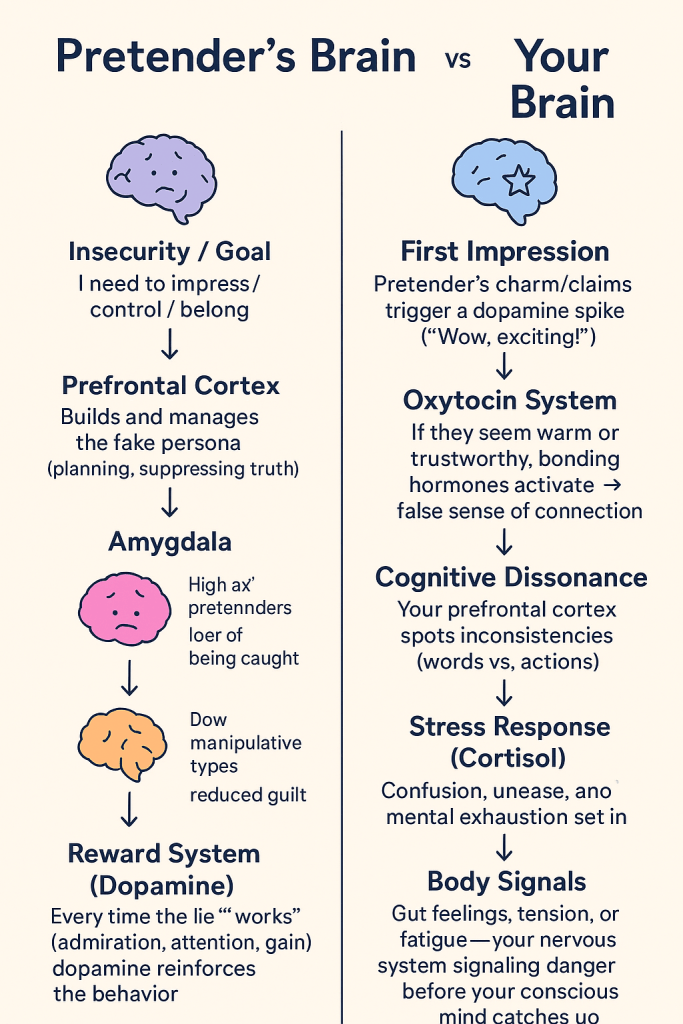
In abusive patterns, the brain’s dopamine system learns that:
Control → relief → reward
Accountability means:
- That reward loop is dismantled
- The person tolerates anxiety without using power or dominance
- New rewards form around restraint, repair, and respect
This takes months to years, not weeks.
6. Repair replaces justification
Accountable brains:
- Focus on impact, not intent
- Make repairs without demanding outcomes
- Accept permanent consequences
Neurologically, this means the ego no longer overrides reality.
🔹 You’ll hear:
- “I understand why you don’t trust me.”
- “I don’t expect forgiveness.”
- “I’ll continue the work whether you’re here or not.”
Anything else is self-protection, not accountability.
How to tell the difference quickly
Not accountability sounds like:
- “I’ve changed” (without evidence)
- “I feel terrible” (centres them)
- “I’d never do that again” (future promise)
- “Why can’t you move on?”
Real accountability looks like:
- Behavioural consistency under stress
- Long-term external support (specialist therapy, not general counselling)
- Acceptance of boundaries without resentment
- No urgency for reconciliation
The hardest truth
Most people who abuse do not reach neurological accountability.
Not because it’s impossible —
but because it requires dismantling entitlement, tolerating shame, and giving up control with no guarantee of reward.
That level of internal work is something only the person themselves can choose.
 Linda C J Turner | Trauma Therapist & Emotional Healing Specialist