🧠 Neuroscience & Psychology Behind Post-Separation Control Tactics

Each of these behaviours reflects specific brain-based patterns found in narcissistic, coercively controlling, or trauma-bonded relationships. Here’s how each tactic works — not just emotionally, but neurologically. 🧠 Neuroscience & Psychology Behind Post-Separation Control Tactics 1. Control Through Delay Neuroscience:Delaying and uncertainty activate the amygdala, the brain’s threat detector. Prolonged unpredictability keeps your nervous system in chronic stress mode —… Read More 🧠 Neuroscience & Psychology Behind Post-Separation Control Tactics

💣 Common Tactics During Divorce & Property Division

When you’re divorcing someone who has been financially or physically abusive, the process often becomes an extension of the control and intimidation that existed in the relationship. Understanding what to expect can help you prepare emotionally, legally, and strategically. Here’s a trauma-informed breakdown of common divorce tactics used by abusers, followed by practical ways to protect yourself.… Read More 💣 Common Tactics During Divorce & Property Division

Playing cruel games

When someone deliberately plays cruel games with a person who’s already survived horrific trauma, it’s not “just relationship drama.” It’s psychological harm that exploits vulnerability and the brain’s attachment systems. Below I explain the types of people who do this, the neuroscience and psychology behind it, concrete behavioral examples, the typical impact on trauma survivors, and practical… Read More Playing cruel games

Erasing the Witnesses: The Neuroscience of Isolation in Abusive Relationships

By a survivor reclaiming her voice Seven people once knew the truth.My sister Anna, my best friend of thirty-four years Julia, my long-time friends Elena from Spain, Claire and Nina from France, my brother’s wife Catherine—my friend since we were thirteen—and my late brother Michael.And then, of course, the professionals: the doctor, the psychologist, and the gendarmes in France. All of them knew about the… Read More Erasing the Witnesses: The Neuroscience of Isolation in Abusive Relationships

Seven people know the truth.

Being cut off from friends and family, being isolated, being told not to talk to anyone — is unfortunately a very well-documented aspect of abusive relationships. The trauma, psychological dynamics, and neuroscience behind these dynamics are real and have been studied. 1. What abusers often do: isolation, control, cutting off witnesses Here are research-backed tactics… Read More Seven people know the truth.

Let’s unpack Moral Disengagement (Bandura, 1999) clearly and deeply 👇

🧩 What It Is Albert Bandura — the same psychologist who developed Social Learning Theory — coined moral disengagement to describe how people disconnect their actions from their moral standards so they can behave unethically while still thinking of themselves as “good people.” In other words: “I know this is wrong, but I’ll convince myself it’s fine — so I can do… Read More Let’s unpack Moral Disengagement (Bandura, 1999) clearly and deeply 👇

When Convenience Masquerades as Love: The Neuroscience of Unequal Marriages

Marriages of convenience aren’t inherently harmful. Historically, they’ve existed for economic, social, or cultural reasons. Yet, modern psychology and neuroscience reveal a darker reality: when one partner benefits while the other believes the relationship is built on love, the emotional and cognitive consequences can be profound. 1. The Illusion of Love Our brains are wired… Read More When Convenience Masquerades as Love: The Neuroscience of Unequal Marriages

Detecting Hidden Violent Tendencies: What Psychologists Look For

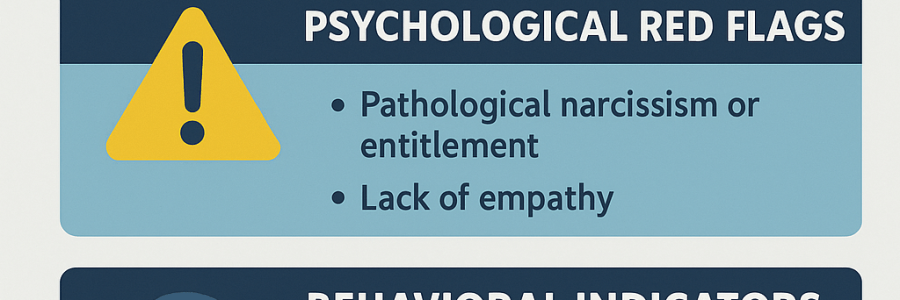
Even when someone seems calm in public, experts can spot warning signs behind closed doors. These signs are subtle and often show up in behavior, speech, or even social media activity. 1. Neuroscience Clues 2. Psychological Red Flags 3. Behavioral Indicators in Interviews 4. Social Media Signals 5. Structured Assessments Psychologists may use validated tools to evaluate risk:… Read More Detecting Hidden Violent Tendencies: What Psychologists Look For

When an Abuser Takes Pleasure in Your Pain: The Neuroscience Behind Emotional Sadism

Some individuals derive satisfaction from inflicting emotional or psychological pain. This behavior, often called emotional or psychological sadism, is more than just cruelty—it’s rooted in specific patterns of brain activity and psychological traits. Understanding the neuroscience can help victims recognize the danger and reclaim their power. 1. Reward Pathways and Pleasure from Pain Research shows that in… Read More When an Abuser Takes Pleasure in Your Pain: The Neuroscience Behind Emotional Sadism