When They Threaten You with Court to Control You

The psychology behind false defamation claims and emotional manipulation Sometimes, the people who shout the loudest about “defamation” are the very ones who’ve been spreading rumours themselves. When someone makes damaging or unkind comments about their own family and then threatens to take you to court for simply repeating or acknowledging them, it’s rarely about truth —… Read More When They Threaten You with Court to Control You

 Friendship differs from a romantic relationship

Let’s look at how friendship differs from a romantic relationship, both in the mind and in the brain. 🧠 Neuroscience Perspective 1. Shared biological systems Both friendship and romantic love activate the brain’s reward circuitry — especially areas like: The difference lies in intensity and neural targets. Function Friendship Romantic Relationship Reward Activation Moderate dopamine release (comfort, joy, familiarity) Strong dopamine surge (euphoria, craving, desire)… Read More  Friendship differs from a romantic relationship

Friendship

Friendship, in its broadest sense, is a voluntary, reciprocal relationship based on trust, affection, shared interests, and mutual support. When we consider friendship between a man and a woman, both neuroscience and psychology provide insights into its nature, dynamics, and unique aspects. Let’s break it down carefully. 1. Psychological Perspective Core elements of friendship: Unique aspects… Read More Friendship

🧠 1. The neuroscience of denial: fear and self-protection

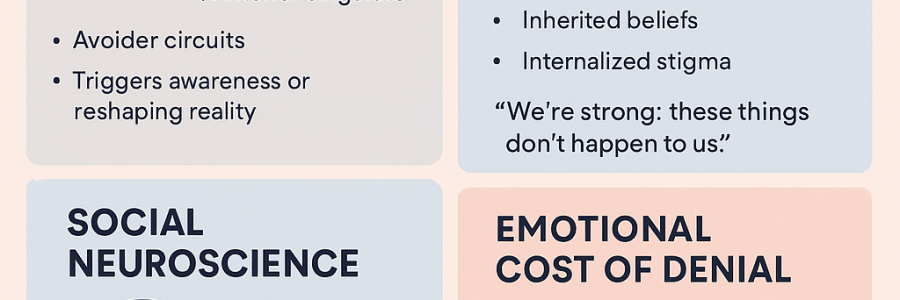
Denial is not just psychological — it’s neurobiological.When the brain encounters something threatening to identity, reputation, or emotional safety, the amygdala (fear center) and anterior cingulate cortex (conflict detector) activate.This triggers avoidance circuits — the brain unconsciously blocks awareness or reshapes reality to reduce emotional pain. In other words: “If I don’t admit it, I don’t have to feel it.” The brain… Read More 🧠 1. The neuroscience of denial: fear and self-protection

“The Psychology of Projection: When the Real Controller Says ‘They’re Trying to Control You’”

You heard it over and over:“They’re trying to control you.”Your family. Your friends. Anyone who cared about you —he cast them all as the enemy. But in truth, it was never them.It was him. Psychologically, this is a classic tactic of projection — one of the most common defense mechanisms in controlling or narcissistic personalities.Projection happens when a person… Read More “The Psychology of Projection: When the Real Controller Says ‘They’re Trying to Control You’”

Moral Equilibrium and the Brain: Regret, Empathy, and Compassion

Moral equilibrium is the inner drive to restore balance when someone feels that actions or decisions have violated their own or societal moral standards. It’s the part of us that says, “I wish I had acted differently.” Psychological Perspective From a psychological standpoint, people often experience moral regret when they recognize that an opportunity to act with empathy… Read More Moral Equilibrium and the Brain: Regret, Empathy, and Compassion

When Compassion Is Withheld: The Psychology and Neuroscience of Truth and Accountability

When people act without compassion, dismiss your pain, or ignore the truth you’ve spoken, something powerful happens in both psychology and the brain: the natural human instinct for fairness and truth becomes activated. This isn’t revenge — it’s restoration. The Psychology of Reciprocity and Justice In social psychology, reciprocity is a fundamental principle. Humans are wired to… Read More When Compassion Is Withheld: The Psychology and Neuroscience of Truth and Accountability

Why they switch to insults — psychology

If intimidation (threats, legal bluster, looming consequences) doesn’t get the response the abuser wants, they often switch to insults and verbal abuse. Here’s a clear, short psychology + neuroscience explanation and practical guidance you can use. Why they switch to insults — psychology Why insults hurt — neuroscience (brief, cautious) Practical steps you can take

The Neuroscience of Sadistic Personality Traits: When Cruelty Becomes Rewarding

Some individuals don’t just hurt others for gain — they hurt because it feels good. This is the unsettling core of sadistic personality traits: deriving pleasure, excitement, or even arousal from another person’s suffering. While many people can act aggressively under certain conditions, true sadism involves pleasure from pain — an active pursuit of cruelty for its own… Read More The Neuroscience of Sadistic Personality Traits: When Cruelty Becomes Rewarding

Defense Mechanisms

1. Compartmentalization 2. Cognitive Dissonance 3. Trauma and Family Dynamics 4. Emotional Blind Spots 5. Social and Moral Pressures In short: The mind and brain are remarkably capable of holding contradictions. Someone can care deeply about child welfare in society while being psychologically, emotionally, or neurologically “blind” to abuse in their own family. Fear, shame, loyalty, cognitive dissonance, trauma, and… Read More Defense Mechanisms