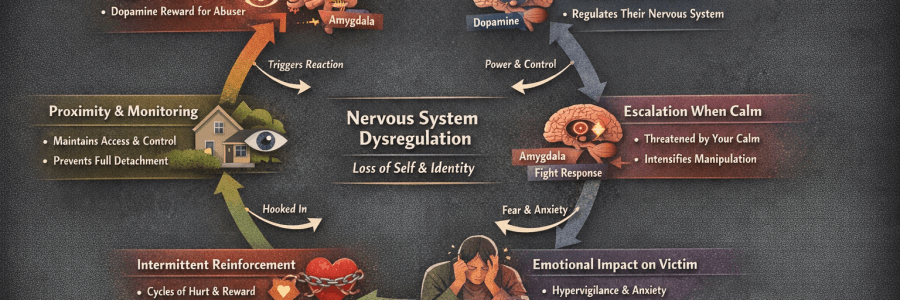
Why Leaving Abuse Is a Medical Intervention

Leaving abuse is not just a personal decision.It is not just emotional courage.It is not just psychological survival. It is a medical intervention. 🧠 Abuse Is a Biological Injury Chronic abuse — emotional, psychological, physical, financial, or coercive — forces the human nervous system into constant survival mode. This creates: In medicine, this is known as chronic… Read More Why Leaving Abuse Is a Medical Intervention

What Physical Illnesses Can Trauma Cause?

Trauma dysregulates the nervous system, immune system, endocrine (hormonal) system, and inflammatory pathways, which can lead to real, diagnosable physical illness. This is not “in your head.”This is body-based biology. 🔥 Chronic Stress & Nervous System Dysregulation Long-term trauma keeps the body stuck in fight / flight / freeze mode. This leads to: Over time, this creates system-wide physical illness.… Read More What Physical Illnesses Can Trauma Cause?

Why Some People Create Convincing Emotional Masks

(Especially When Desperate for Money & Lifestyle) 1. Survival Brain Overrides Moral Brain When someone is financially desperate, the brain shifts into survival mode. This activates: In survival mode: Short-term survival > long-term ethics So the brain prioritizes: Not authenticity. This is not conscious evil.It’s biological threat adaptation. 2. Dopamine Hijacking: Lifestyle = Reward Addiction Luxury, comfort, validation,… Read More Why Some People Create Convincing Emotional Masks

🧠 1. Neuroscience: Low Dopamine & Emotional Fatigue

When someone feels “tired” all the time — not just physically, but existentially — it often reflects dopamine depletion or chronic stress response. So when he says “I’m old, tired, and sick,” his brain might literally be signaling burnout or emotional depletion, not just age. 🧩 2. Psychological Interpretation: Emotional Withdrawal or Learned Helplessness If this phrase is repeated frequently, it… Read More 🧠 1. Neuroscience: Low Dopamine & Emotional Fatigue

The Neuroscience of Rediscovering Joy After Control

When you have lived for years under constant criticism, judgment, and control, your nervous system learns to stay on high alert. Neuroscientists call this hypervigilance—a state where the brain’s threat-detection system, especially the amygdala, is overactive. You end up walking on eggshells, anticipating the next complaint, the next miserable look, the next outburst. This robs your body… Read More The Neuroscience of Rediscovering Joy After Control

🥦 Trauma Recovery and Nutrition: Why Eating Well Helps You Heal

When we think of trauma recovery, most of us think of therapy, journaling, or support groups. But what we often overlook is something we do multiple times a day: eating. What you eat profoundly affects how you feel, how your brain functions, and how your body recovers from stress. In trauma therapy, we talk a lot about the… Read More 🥦 Trauma Recovery and Nutrition: Why Eating Well Helps You Heal