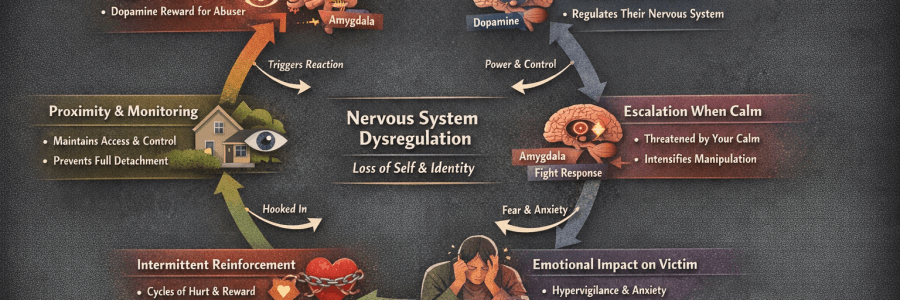
🧠 How Long-Term Exposure to Threat & Harassment Damages Trust and Self-Regulation

Stage-by-Stage Neuropsychological Impact Area Affected What Repeated Threat Exposure Does Long-Term Consequence Amygdala (Threat Detector) Becomes hypersensitive Constant alertness, anxiety, startle response Prefrontal Cortex (Self-regulation) Overridden repeatedly Difficulty concentrating, decision fatigue Hippocampus (Memory & Context) Stores events as danger memories Triggers activated by reminders, emails, names Vagus Nerve (Calming Pathway) Under-stimulated Trouble calming after stress… Read More 🧠 How Long-Term Exposure to Threat & Harassment Damages Trust and Self-Regulation
Why some people literally cannot grasp another perspective

1. Prefrontal cortex maturity (or lack of it) Perspective-taking, empathy, and reflective thinking live mainly in the prefrontal cortex (PFC) — especially: If someone is emotionally immature, stressed, personality-disordered, or chronically defensive, these areas are functionally offline in conflict. ➡️ They are not choosing not to understand you — their brain cannot access the circuitry required to do so in that moment.… Read More Why some people literally cannot grasp another perspective

Stress and Threat Response

1. Legal Actions You Can Take When an ex’s family member sends derogatory, threatening, or manipulative messages aimed at influencing a financial settlement or your reputation, the law provides several protections: a. Document Everything b. Civil Legal Options c. Criminal Considerations d. In Court 2. Psychological and Neuroscience Impact Being targeted like this by a family member,… Read More Stress and Threat Response

🧠 WHY SAFETY IS THE FOUNDATION OF HEALING

1️⃣ Trauma locks the nervous system in survival mode Impact: The brain and body are busy keeping you alive, not updating memories or integrating experience. 2️⃣ Safety switches on the prefrontal cortex Neuroscience truth: Without safety, the brain can’t distinguish between old threat and present reality. Effort alone does not override this — it only increases stress. 3️⃣ Legal protections… Read More 🧠 WHY SAFETY IS THE FOUNDATION OF HEALING

🧠 ANGER vs GRIEF IN TRAUMA RECOVERY

(Brain → function → outcome) 🔥 ANGER Purpose: protection and containment 🧠 Brain state 🧭 Function after trauma Anger says: “This should not have happened.” That is a healthy early response. 🧍 Behavioural expressions 🧠 Nervous-system effect This is why anger often comes before grief. 🌊 GRIEF Purpose: integration and release 🧠 Brain state 🧭 Function after trauma… Read More 🧠 ANGER vs GRIEF IN TRAUMA RECOVERY

🧠 HOW “I’M ALWAYS RIGHT” LINKS TO NARCISSISTIC DEFENCES

(Defence ≠ disorder) 1️⃣ THE CORE ISSUE IS SHAME, NOT GRANDIOSITY At the centre of narcissistic-style defences is unprocessed shame. Not: The brain builds certainty as armour. 2️⃣ THE NEUROSCIENCE OF DEFENSIVE CERTAINTY 🧠 Brain mechanics Being wrong triggers the same brain response as danger. So the brain says: “Never be wrong.” 3️⃣ CERTAINTY AS A SELF-STABILISER… Read More 🧠 HOW “I’M ALWAYS RIGHT” LINKS TO NARCISSISTIC DEFENCES

🧠 WHAT “I’M ALWAYS RIGHT” DOES TO THE BRAIN

1️⃣ The brain stops learning Neuroscience Result Certainty feels safe — but it is neurologically anti-growth. 2️⃣ The amygdala takes over Being wrong activates threat circuits. If your identity depends on being right: Brain pattern You’re no longer processing information — you’re protecting the self-image. 3️⃣ Dopamine rewards self-confirmation, not truth Each time you: …the brain… Read More 🧠 WHAT “I’M ALWAYS RIGHT” DOES TO THE BRAIN

🧠 SECURE vs AVOIDANT COMPANIONSHIP BRAINS

(Brain → behaviour → relationship experience) 🟢 SECURE COMPANIONSHIP BRAIN “Connection is safe and mutual.” 🧠 Brain wiring ⬇️ 🧍 Behaviour in early interactions ⬇️ 🔗 Companionship pattern ⬇️ 🧠 Nervous-system effect on you 🔴 AVOIDANT COMPANIONSHIP BRAIN “Connection is useful but dangerous.” 🧠 Brain wiring ⬇️ 🧍 Behaviour in early interactions ⬇️ 🔗 Companionship… Read More 🧠 SECURE vs AVOIDANT COMPANIONSHIP BRAINS

WHY EMOTIONALLY REGULATED PEOPLE BECOME MAGNETS

1️⃣ Regulation is a resource the brain can sense Humans unconsciously scan for nervous-system cues. Your signals: To a dysregulated brain, this registers as: “This person can hold me.” That perception alone invites offloading. 2️⃣ Dysregulated systems seek external regulation People who lack self-regulation unconsciously use others to: They are not seeking companionship — they are seeking regulation… Read More WHY EMOTIONALLY REGULATED PEOPLE BECOME MAGNETS

🧠 BRAIN → 🧍 BEHAVIOUR → 🔗 RELATIONSHIP DYNAMICS

1️⃣ CHRONIC STRESS / SCARCITY BRAIN (Financial stress, housing insecurity, burnout, emotional depletion) 🧠 Brain state ⬇️ 🧍 Behaviour ⬇️ 🔗 Relationship outcome 2️⃣ DOPAMINE-CONDITIONED BRAIN (Novelty, convenience, instant gratification culture) 🧠 Brain state ⬇️ 🧍 Behaviour ⬇️ 🔗 Relationship outcome 3️⃣ AVOIDANT / ENTITLED NERVOUS SYSTEM (Often unconscious, not always malicious) 🧠 Brain state… Read More 🧠 BRAIN → 🧍 BEHAVIOUR → 🔗 RELATIONSHIP DYNAMICS