What Happens When You Ignore Your Intuition and Go Into Denial
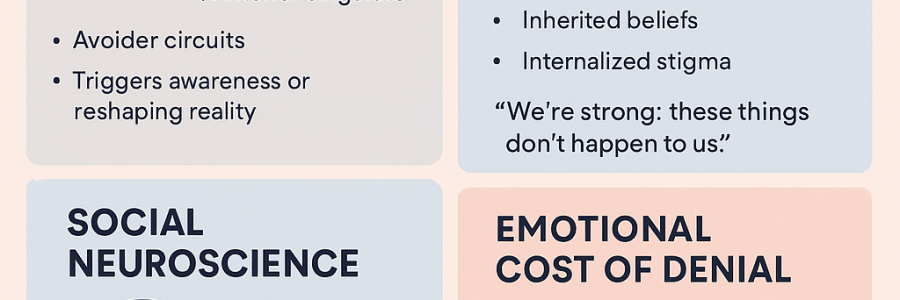
(“My brain knows better” — until it doesn’t) When intuition signals danger and the conscious mind overrides it, the nervous system doesn’t suddenly agree and stand down.It escalates. Denial isn’t calm reasoning — it’s a stress response driven by fear, conditioning, or wishful thinking. Your brain isn’t “being logical”; it’s trying to avoid discomfort, loss, or… Read More What Happens When You Ignore Your Intuition and Go Into Denial

Never Ignore Your Intuition or Gut Feeling: The Neuroscience Behind Why

Your intuition isn’t magical.It’s biological intelligence. What people call a “gut feeling” is your nervous system processing information faster than conscious thought — and trying to keep you safe. 1. Your Body Detects Threat Before Your Mind Can Explain It The brain receives far more sensory data than you can consciously process.Your amygdala and insular cortex scan for danger, inconsistency, and pattern… Read More Never Ignore Your Intuition or Gut Feeling: The Neuroscience Behind Why

1. Why Kind People Are Targeted by Emotional Freeloaders

Kind people aren’t targeted because they’re weak.They’re targeted because they’re reliable sources of emotional regulation. From a psychology and neuroscience perspective, emotional freeloaders instinctively gravitate toward people who: Your nervous system soothes theirs. The Neuroscience Angle Humans unconsciously seek external regulation when they can’t regulate themselves.If someone lacks emotional regulation skills, their brain looks for another nervous… Read More 1. Why Kind People Are Targeted by Emotional Freeloaders

What Emotional Freeloading Looks Like

Emotional freeloading is when someone takes emotional support, care, attention, or stability from another person without giving it back, taking responsibility, or showing genuine empathy in return. It’s not a clinical diagnosis, but it’s a very accurate psychological description of a pattern many people recognise instantly once they’ve lived it. What Emotional Freeloading Looks Like An emotional freeloader: They… Read More What Emotional Freeloading Looks Like

A Breath of Fresh Air: Why Meeting the Right People Restores Your Faith in Humanity

Every now and then, someone walks into your life and reminds you that not all humans are chaotic, exhausting, or emotionally under-evolved.A calm, intelligent, good-looking man.A relaxed evening.No drama.No hidden agenda.Just connection. It’s astonishing how something so simple can feel like oxygen when you’ve been living under emotional rubble. 1. Your Nervous System Responds to… Read More A Breath of Fresh Air: Why Meeting the Right People Restores Your Faith in Humanity

Why Smart, Strong People Fall for the Façade at First

People often ask, “How did you not see it?”But the truth is: the façade is designed to be believable. It’s engineered — psychologically and neurologically — to bypass your instincts. Here’s why so many people fall for it: 1. The Brain Trusts Consistency, Not Honesty The human brain is wired to detect patterns.If someone consistently presents themselves… Read More Why Smart, Strong People Fall for the Façade at First

When Someone Says One Thing Publicly and Does Another Privately: The Neuroscience Behind the Double Life

It’s astonishing how some people can present one story to their family — “I’m going to sell the house,” “I’m doing the right thing,” “Everything is fine” — while living a completely different reality behind closed doors.Nothing ever changes. The promises shift, the words get softer, but the behaviour stays the same. And when someone performs one role for… Read More When Someone Says One Thing Publicly and Does Another Privately: The Neuroscience Behind the Double Life

How the Sunk Cost Trap Operates in Predatory Relationships

Predatory people intentionally front-load the relationship so you invest early, and they invest little.This creates psychological pressure that traps you later. Here’s how it usually works: ⭐ Phase 1 — “Hooking” You With Intensity They create fast closeness: Goal: You form an emotional attachment early.Your brain says: “We’ve started something real.” ⭐ Phase 2 — Getting You to Invest (Emotionally, Financially, or Practically)… Read More How the Sunk Cost Trap Operates in Predatory Relationships

Relief vs. Calm — What’s the difference?

Relief Relief is a reactive physiological‑emotional state. It occurs when a stressor or threat diminishes or ends. For example: you finish a difficult project, get through an argument, narrowly avoid a danger. The tension, vigilance or threat drops and you feel “whew”—that’s relief. In nervous‑system terms, relief often means that your sympathetic (“fight/flight/alert”) system was active or… Read More Relief vs. Calm — What’s the difference?

When Relief Feels Like Love

When you’ve experienced emotional neglect, betrayal, or manipulation, your body adapts before your mind does. Your attachment system—designed to seek safety and predictability—lowers its standards. What once counted as “basic decency” starts to feel like security. The nervous system quietly revises the rules. In this state, not being hurt can register as being loved. When someone is merely… Read More When Relief Feels Like Love