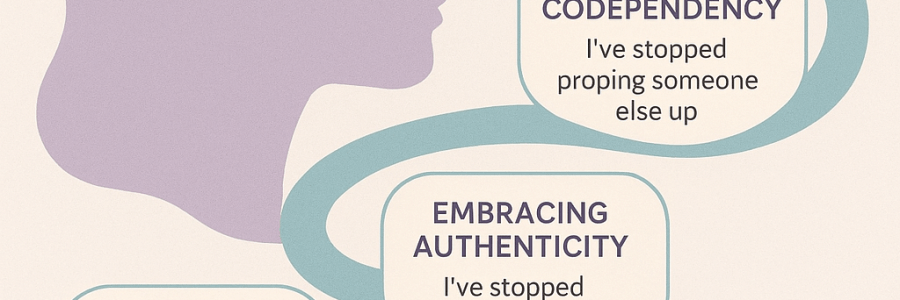
From survival mode to safety mode
1. From survival mode to safety mode For decades, your brain and body were likely dominated by the threat system: Neuroscience shows that long-term emotional abuse keeps the amygdala (threat detector) overactive, while the prefrontal cortex (reasoning, reflection, calm decision-making) gets suppressed. What you’re feeling now — peace, wholeness, comfort — signals a shift into parasympathetic dominance, often called rest and digest.… Read More From survival mode to safety mode

Immediate nervous system reset

Putting yourself first after disengaging from someone who is dumping distressing information is essential for nervous system recovery. Here’s a structured, neuroscience- and psychology-informed plan for grounding and stabilizing yourself in the days immediately after: 1. Immediate nervous system reset 🔹 Deep breathing 🔹 Grounding with senses 🔹 Body scan 2. Protect your digital space 3. Structure your… Read More Immediate nervous system reset

Why blocking and stopping contact protects your sanity (neuroscience & psychology)

🧠 1. Your brain did not consent to this role Unsolicited disclosure recruits your nervous system without permission. Neuroscience: You are closing an open stress loop. 🧠 2. Ongoing contact creates “false responsibility” Psychology shows that once contact continues, the brain begins to feel: Even if you intellectually reject this, your nervous system doesn’t. Blocking prevents role… Read More Why blocking and stopping contact protects your sanity (neuroscience & psychology)

Practical and safe approach

Passing the information to your psychologist and discussing it is generally a very safe and effective choice, from both psychology and neuroscience perspectives, because it allows you to process the material without carrying it alone, and it protects your nervous system. Here’s the reasoning: 1. Psychologists are trained containers for trauma 2. Processing without absorbing responsibility 3.… Read More Practical and safe approach

Should you pass the information to your lawyer?

Yes, if ALL of the following are true: Your lawyer’s role is precisely to hold information so you don’t have to. Why this is protective (neuroscience & psychology) 🧠 1. Cognitive offloading This is healthy delegation, not avoidance. 🧠 2. Containment reduces trauma activation Uncontained information keeps trauma circuits “open.” A lawyer provides: Your nervous system needs closure,… Read More Should you pass the information to your lawyer?

Disturbing information

Here is a clear, trauma-informed, neuroscience-aligned way to react when someone you barely know contacts you with a disclosure about your ex — something you didn’t want to know, but that should be reported. This approach protects your nervous system, your legal position, and the integrity of the information. 1. Regulate first — before responding Do nothing immediately. Neuroscience: What to do… Read More Disturbing information

“Does this information increase my safety or only my stress?”

harmful disclosure doesn’t look dramatic at first. Neuroscience shows it often erodes recovery quietly, through stress accumulation rather than acute distress. Here are the clear, evidence-based signs that disclosures are starting to harm your recovery. 1. Your nervous system stays activated after contact Key sign: the reaction doesn’t settle. Neuroscience: You may notice: If your body remains alert long after… Read More “Does this information increase my safety or only my stress?”

God’s Waiting Room: Embracing Impermanence and Meaning

“God’s Waiting Room” is a concept that captures a universal human truth: life is temporary, connections are fleeting, and endings — both small and large — are inevitable. While the term itself isn’t formally named in psychology, it resonates strongly across multiple disciplines and philosophies. 1. Existential Psychology Thinkers like Viktor Frankl and Irvin Yalom… Read More God’s Waiting Room: Embracing Impermanence and Meaning

“This Isn’t New — It’s the Same Game in a Different Arena”Why Long-Term Mind Games Continue After Separation

When you’ve lived with decades of psychological manipulation, the most destabilising part isn’t the behaviour itself. It’s the moment you realise:This is just a continuation of the same pattern. Different setting.Different language.Same impact on your nervous system. That recognition is not bitterness.It’s pattern recognition. What Kind of Person Does This? From a trauma-informed and neuroscience perspective,… Read More “This Isn’t New — It’s the Same Game in a Different Arena”Why Long-Term Mind Games Continue After Separation

How to Deal With This Without Going Crazy(A Trauma-Informed, Neuroscience-Based Guide)

First, an important reframe: If you feel anxious, angry, hyper-alert, exhausted, or mentally foggy in this situation, you are not “going crazy.”Your nervous system is responding normally to an abnormal level of prolonged uncertainty and control. The goal is not to “stay calm.”The goal is to stay regulated enough to function and protect yourself. 1. Stop Treating This… Read More How to Deal With This Without Going Crazy(A Trauma-Informed, Neuroscience-Based Guide)