Financial Exploitation Escalation
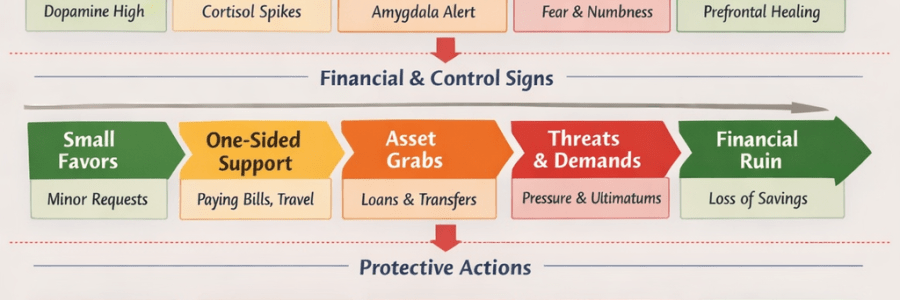
STEP 1: Subtle Dependence STEP 2: Regular Exploitation STEP 3: Secrecy & Manipulation STEP 4: Escalation & Pressure STEP 5: Long-Term Harm Key Features of This Map 🔑 Takeaways
STEP 1: Subtle Dependence STEP 2: Regular Exploitation STEP 3: Secrecy & Manipulation STEP 4: Escalation & Pressure STEP 5: Long-Term Harm Key Features of This Map 🔑 Takeaways
Some people use charm, intimacy, or emotional manipulation to gain financial, domestic, or logistical support from their partner while contributing little or nothing in return. Common behaviours: Example:A partner moves in and promises to “help with the bills later,” but never does, while continuing to enjoy meals, utilities, and travel expenses. 2️⃣ The Risk: Long-Term Financial and… Read More The Tactic: Exploitation of Resources Without Reciprocity
1. Conflict of Interest 2. Financial Vulnerability 3. Lack of Independent Oversight 4. Legal and Emotional Consequences How to Protect Yourself ⚠️ Key Takeaway Trusting a family-affiliated solicitor can risk your financial and legal security. Always verify independently — your assets, your rights, and your future depend on it.

When dealing with family finances, inheritances, or shared assets, it’s important to be aware that not all legal or financial advisors may act impartially, particularly if they have close relationships with family members. To protect yourself: Remember: Protecting your own legal and financial rights is a reasonable and responsible precaution, not a sign of distrust. For additional guidance,… Read More Public Advisory: Protect Yourself from Conflicted or Untrustworthy Legal Advice
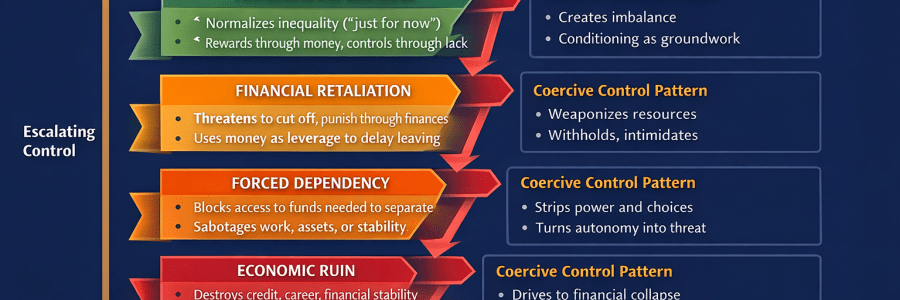
Here is a clear, evidence-based breakdown of real love vs. a financial parasite, grounded in neuroscience, psychology, and behavioural science, with early warning signs your nervous system often detects before your mind does. This is not about wealth.It’s about intent, reciprocity, and conscience. Real Love vs Financial Parasite (Neuroscience & Psychology) CORE DIFFERENCE (at brain level) Real Love “Your wellbeing matters as… Read More Real Love vs Financial Parasite
Financial abuse often hides for years behind respectability, routine, and silence. But over time, it leaks out—not through bank statements, but through patterns others begin to see. Friends and family notice you are still working well past retirement age, while he stopped at 50.They notice you are always restricted with money—especially on girls’ days out.You always… Read More When Others Start to Notice: The Psychology of Financial Abuse in Plain Sight
Financial abuse often develops gradually and is easy to miss while you are inside it. If several of the following are present, it is not miscommunication or poor money management—it is coercive control. Access & Control Information Withholding Restriction & Dependency Labour Without Security Fear, Compliance & Consequences Separation & Future Control Your Inner Signals If… Read More Financial Abuse Warning-Sign Checklist
Financial abuse is often invisible while it is happening. It hides behind marriage, duty, trust, and time. Many people assume it is about money mismanagement or selfishness. In reality, it is about control, dependency, and long-term deprivation. After three decades of marriage, I discovered that the plan was always to leave me with nothing. Alternative wills… Read More Financial Abuse: When Control Is the Plan From the Start

2. Economic abuse and predatory financial service use 3. Vulnerability to financial exploitation 4. Romance fraud / relationship-based financial exploitation 🔍 Gaps & Considerations 🧾 Summary these patterns you do align very strongly with recorded research on financial/relationship-exploitation. These key points emerge:

1. The relationship accelerates before trust is earned 2. Money enters the conversation early (even indirectly) 3. Urgency + emotion are used together 4. Boundaries are subtly punished 5. Promises don’t match patterns 6. The balance is one-sided Ask yourself: 7. Your body notices before your mind 🛡️ A Simple Test (Use Early) Try this once: “I… Read More Early Signs Someone Is Using You Financially
 Linda C J Turner | Trauma Therapist & Emotional Healing Specialist