How Healthy Partners Behave — Even During Separation

This is a crucial distinction, especially during separation or divorce when stress is high.Healthy partners may be hurt, angry, or grieving — but they do not cross core moral lines, even when the relationship ends. Below is how this looks psychologically, neurologically, and behaviorally. How Healthy Partners Behave — Even During Separation (Neuroscience & Psychology) 1. They Do… Read More How Healthy Partners Behave — Even During Separation

“Once someone is willing to lie under oath, the relationship is already dead.”

“Once someone is willing to lie under oath, the relationship is already dead.” Here’s why — grounded in neuroscience, psychology, and ethics: Why Lying Under Oath Kills a Relationship Permanently 1. It Destroys the Brain’s Safety Model The human attachment system relies on one core question: “Is this person fundamentally safe and truthful?” Lying under oath… Read More “Once someone is willing to lie under oath, the relationship is already dead.”

The Unforgivable Lines in a Relationship

Below is a clear, non-negotiable framework used in trauma psychology, family law, and neuroscience to define lines that must never be crossed in an intimate relationship.These are not “relationship problems.” They are moral, neurological, and legal violations that permanently damage trust and the human nervous system. The Unforgivable Lines in a Relationship (Neuroscience & Psychology perspective) 1. Violence or Threats of… Read More The Unforgivable Lines in a Relationship

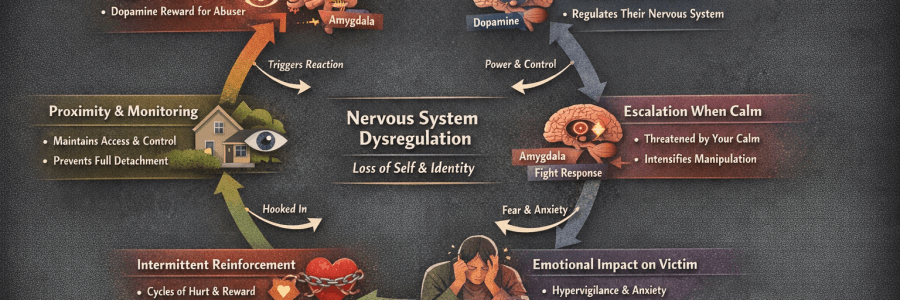
Cycle of Long Term Abuse

button-pushing, escalation when calm, reliance on your reactions for regulation, and staying close to you physically or symbolically — is actually a hallmark of long-term emotional abuse. Let’s unpack why this is, from both a psychological and neurological perspective. 1. Emotional Abuse Is About Control, Not Connection Long-term emotional abuse isn’t about conflict or even “anger.” It’s… Read More Cycle of Long Term Abuse

When calm unsettles someone

Calm feels threatening to these people because calm removes the very thing their nervous system depends on to feel real, powerful, or regulated. This isn’t metaphorical — it’s neurological. Here’s what’s happening underneath the behavior. 1. Calm Starves Their Reward System For people who provoke reactions, emotional intensity is the reward. Provocation → your reaction → dopamine.… Read More When calm unsettles someone

Pushing your buttons

When someone openly admits they push your buttons “to see you react,” it’s not accidental or unconscious — it’s deliberate and rewarding to them. Here’s what’s happening neurologically and psychologically. 1. They Are Regulating Themselves Through Your Reaction For some people, especially those with coercive, antagonistic, or narcissistic traits, other people’s emotional reactions function as a… Read More Pushing your buttons

Identity destabilizes without an audience

When proximity stops working, some abusers escalate not because they want more connection — but because their primary regulation strategy has failed. What follows is not emotion-driven in the way healthy grief is; it’s a threat response. Here’s the neuroscience and psychology behind that escalation. 1. Proximity Was Their Regulator — Its Loss Feels Like Threat For… Read More Identity destabilizes without an audience

Why Abusers Often Refuse to Leave the Area

This is not coincidence, nostalgia, or practicality.It is about regulation, identity, and power. The key distinction: So they stay close. 1. Proximity Regulates Their Nervous System For an abuser, proximity to a former target functions like a regulatory anchor. Neurologically: reduces their internal anxiety. Even imagined access calms: They don’t need contact.They need potential access. Distance removes that — and their… Read More Why Abusers Often Refuse to Leave the Area

Abusers do not seek connection — they seek regulation.

When an abuser leaves reminders, resurfaces after long no-contact, or engineers moments where you “happen” to see them, there is a very specific neuropsychological mechanism at play. I’ll break it down clearly and calmly. The Core Truth Abusers do not seek connection — they seek regulation. They use you to regulate their nervous system, identity, and sense of… Read More Abusers do not seek connection — they seek regulation.